Arch of Constantine: Rome's Triumphal Masterpiece & Complete Guide (2026)
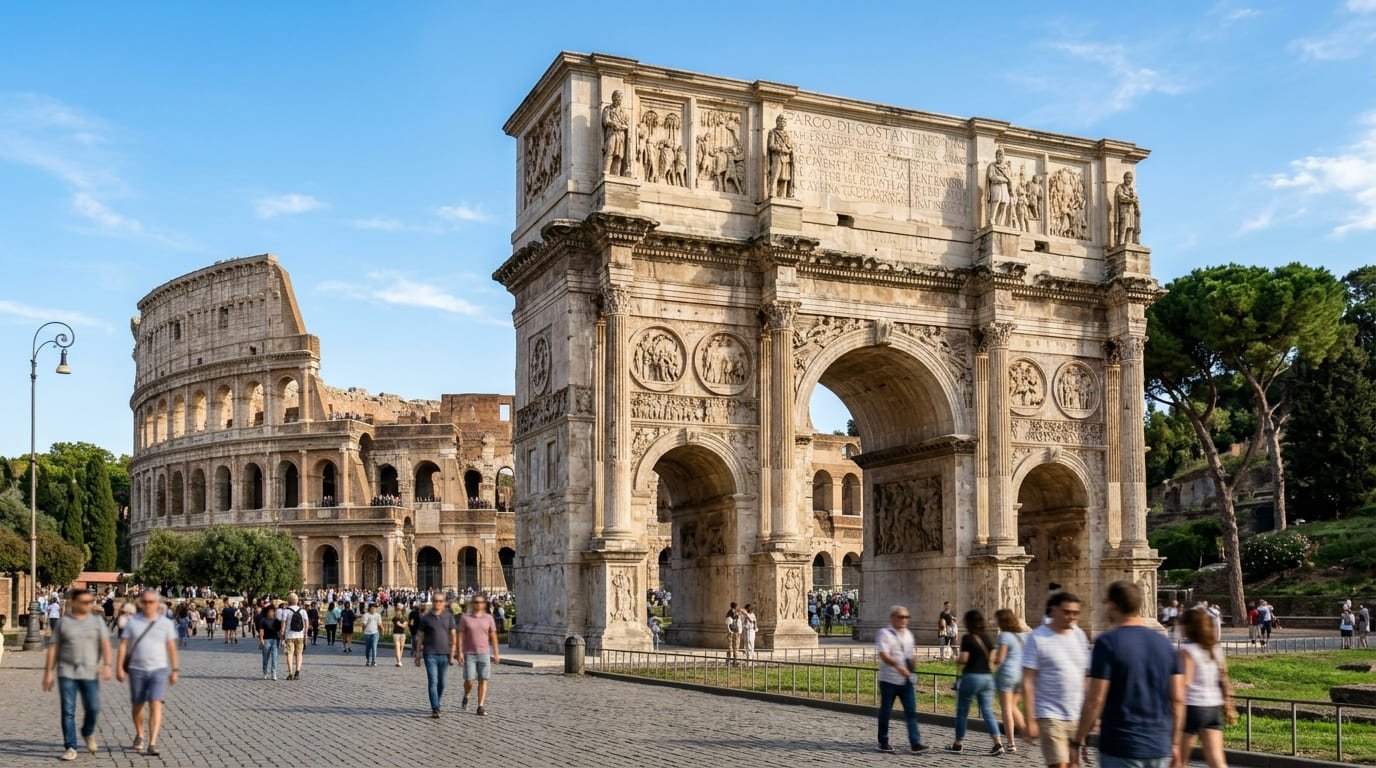
Standing majestically on the pedestrian plaza between the Colosseum and the Palatine Hill, the Arch of Constantine (Arco di Costantino) is Rome's largest, best-preserved triumphal arch - erected in 315 AD to celebrate Emperor Constantine's historic victory at the Milvian Bridge.
📖 Table of Contents
History: Constantine & The Battle of the Milvian Bridge
On October 28, 312 AD, the course of Western history shifted on the northern banks of the Tiber River. In the climactic Battle of the Milvian Bridge, Emperor Constantine I defeated his rival Maxentius to become the sole ruler of the Western Roman Empire. Standing right outside the monument, the arch is the primary gathering point for holders of Colosseum guided tours and Colosseum tickets.
According to ancient Christian historians Lactantius and Eusebius, Constantine had a vision on the eve of the battle: a radiant cross in the heavens accompanied by the words "In hoc signo vinces" ("In this sign, you shall conquer"). Ordering his legionnaires to paint the Chi-Rho monogram onto their shields, Constantine triumphed, leading directly to the Edict of Milan (313 AD) which legalized Christianity across the Roman world.
Architecture: The Three Arches & Dimensions
Standing 21 metres high and nearly 26 metres wide, the arch features a central bay flanked by two smaller lateral archways. Constructed from brick-faced concrete clad in magnificent Proconnesian and Pentelic white marble, the monument straddled the Via Triumphalis - the sacred ceremonial route taken by victorious Roman generals marching into the Roman Forum.
The Art of 'Spolia': Reused Imperial Sculptures
The most fascinating aspect of the Arch of Constantine is its deliberate use of spolia (reused architectural reliefs and statues taken from earlier monuments):
Eight colossal standing statues of captured Dacian warriors carved from pavonazzetto marble decorating the attic level, salvaged from the Forum of Trajan.
Eight circular medallions (tondi) portraying Emperor Hadrian hunting boars, lions, and bears, and sacrificing to Apollo, Diana, and Hercules.
Eight large relief panels depicting the philosopher-emperor pardoning German prisoners, addressing his troops, and entering Rome in triumph.
Why Did Constantine Reuse Older Art?
While 19th-century historians claimed Romans had lost sculptural skill by the 4th century, modern scholars recognize this as shrewd political messaging. By recarving the faces of the "Good Emperors" (Trajan, Hadrian, and Marcus Aurelius) into his own likeness, Constantine legitimized his rule as the rightful heir to Rome's golden age.
The Famous Inscription: 'Instinctu Divinitatis'
Chiseled into the attic above the central archway is a Latin inscription that has sparked historical debate for centuries:
"To the Emperor Caesar Flavius Constantinus Maximus... who by the inspiration of the divinity (instinctu divinitatis) and the greatness of his mind, with his army avenged the state with righteous arms..."
The ambiguous phrase "instinctu divinitatis" was crafted deliberately by the pagan Roman Senate: it was vague enough to please Christian sympathizers without directly offending the conservative pagan majority of Rome.
How to Visit & Photography Advice
The Arch of Constantine sits on the public pedestrian square directly between the Colosseum and the entrance to the Roman Forum. It is free to view 24 hours a day, 365 days a year with no tickets required.
Photo Tip: Stand approximately 20 metres southwest of the arch near the entrance to Palatine Hill. From here, you can capture the Arch of Constantine in the foreground with the towering curved facade of the Colosseum majestically framing the background.
Frequently Asked Questions
Standard general admission includes Colosseum Levels 1 & 2, the Roman Forum, and Palatine Hill. Special areas like the Arena Floor and Underground require specific upgraded tickets or guided tours.
Colosseum tickets and guided tours sell out rapidly in 2026. For peak months (April to October), book 2 to 4 weeks ahead to secure your desired entry time slot.
Colosseum entry is tied to your specific booked time slot. Access to the Roman Forum and Palatine Hill is valid on the same ticket for 24 hours from your first entry.
Airport-style security checkpoints with metal detectors and X-ray scanners are mandatory for all visitors. Expect waiting times of 15–20 minutes at security, even with fast-track reserved slots.
Yes, official guided tours are offered in English, Italian, Spanish, French, German, and several other languages daily. Wireless headsets are provided so you can hear your licensed guide clearly.