📖 Table of Contents
The Five Seating Tiers Explained
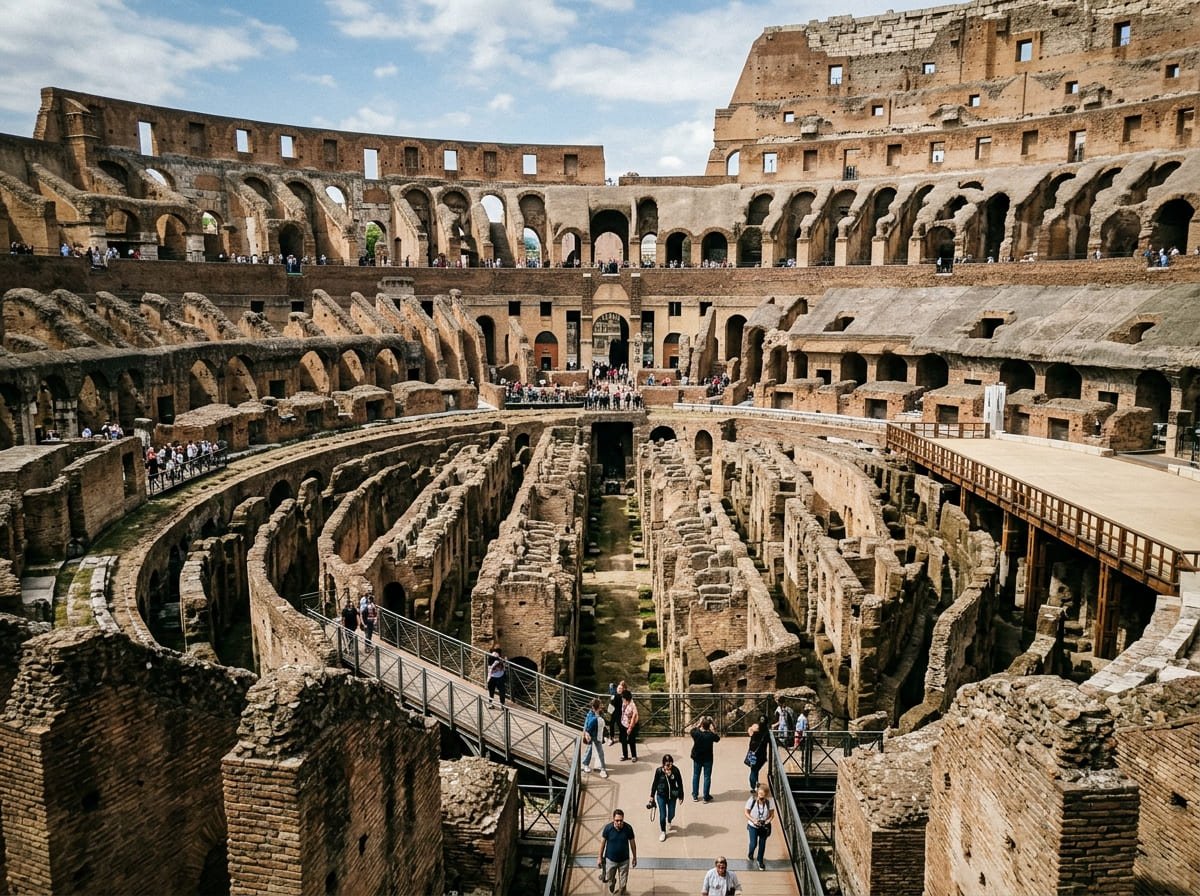
By Roman law (specifically the Lex Julia Theatralis established under Emperor Augustus), public spectacle seating was rigorously segregated by social class, gender, and citizenship. The closer you sat to the arena sand, the higher your social standing: Levels 1 and 2 are open to standard ticket holders. Secure your timed-entry reservation with pre-booked Colosseum tickets.
Tier 1: The Podium (Ground Level)
Elevated approximately 4 metres above the arena floor for safety, the Podium contained the finest seats in the house. Clad in luxurious white Carrara marble, it accommodated Rome's ruling elite:
- The Pulvinar (Imperial Box): Located on the north and south axes, providing the Emperor, Empress, and Vestal Virgins with front-row seats shaded by canopies.
- Senatorial Benches: Rome's 600 senators sat on individualized, portable bronze-and-marble chairs (curule chairs). Today, visitors can still see ancient senatorial names chiseled into the surviving marble balustrades.
Tiers 2 & 3: Knights & Roman Citizens
Ascending above the podium were the broad tiers reserved for the backbone of Roman civil society:
- Tier 2 - Maenianum Primum: Reserved for the Equites (equestrian class or knights), the wealthy mercantile and business aristocracy of Rome. Comprising 14 rows of finely carved marble benches.
- Tier 3 - Maenianum Secundum: Divided into two sections:
- Imum (Lower): Reserved for wealthy male Roman plebeians wearing formal white togas.
- Summum (Upper): Reserved for lower-income plebeians, common soldiers, and foreign dignitaries.
Tiers 4 & 5: The Attic & Wooden Gallery
At the very top of the amphitheatre, nearly 50 metres above the sand, sat those with the lowest status in Roman law:
- Tier 4 - Maenianum Summum: Marble benches occupied by non-citizen freedmen (former slaves) and foreigners.
- Tier 5 - Maenianum Summum in Ligneis (The Wooden Gallery): A steep, covered wooden colonnade standing at the summit. By Augustus's decree, women of all classes (except the sacrosanct Vestal Virgins) were relegated to these wooden benches, alongside enslaved laborers and day workers who had no citizenship rights. While the view of the arena was distant, it provided the best protection against rain.
The 76 Vomitoria: How 50,000 People Exited
The Latin term vomitorium translates literally to "spewing forth" - describing the ingenious vaulted passageways and stairwells that allowed massive crowds to enter and exit the monument rapidly.
Spectators held clay tokens (tesserae) marked with an entrance arch number (I through LXXVI), a tier section, and a row. The numbers are still visible today carved above the ground-level arches. This brilliant flow design allowed an astonishing 50,000 to 70,000 spectators to fill or evacuate the stadium in less than 15 minutes.
The Velarium: The Colosseum's Retractable Roof
To shield spectators from Rome's blazing summer heat, the Colosseum featured a massive retractable canvas awning called the Velarium. Suspended from 240 vertical timber masts mounted on exterior travertine corbels at the attic level, the awning was rigged with an intricate network of ropes and pulleys.
Because the operation required expert seafaring skill, a dedicated detachment of imperial Roman sailors from the naval fleet at Misenum (stationed nearby at the Castra Misenatium) was permanently assigned to furl, unfurl, and adjust the giant sunshades based on wind and sun angles.
Frequently Asked Questions
Standard general admission includes Colosseum Levels 1 & 2, the Roman Forum, and Palatine Hill. Special areas like the Arena Floor and Underground require specific upgraded tickets or guided tours.
Colosseum tickets and guided tours sell out rapidly in 2026. For peak months (April to October), book 2 to 4 weeks ahead to secure your desired entry time slot.
Colosseum entry is tied to your specific booked time slot. Access to the Roman Forum and Palatine Hill is valid on the same ticket for 24 hours from your first entry.
Airport-style security checkpoints with metal detectors and X-ray scanners are mandatory for all visitors. Expect waiting times of 15–20 minutes at security, even with fast-track reserved slots.
Yes, official guided tours are offered in English, Italian, Spanish, French, German, and several other languages daily. Wireless headsets are provided so you can hear your licensed guide clearly.