📖 Table of Contents
What Are the Imperial Fora?
By the end of the Roman Republic in the 1st century BC, Rome had grown into a teeming metropolis of nearly one million inhabitants. The old Roman Forum had become hopelessly congested with courts, markets, and political rallies. Extend your ancient Roman walk along Via dei Fori Imperiali immediately after your scheduled Colosseum tickets visit.
To solve the overcrowding and glorify their own regimes, Rome's absolute rulers purchased expensive urban land adjacent to the old Forum and constructed five monumental, interconnected marble plazas known collectively as the Imperial Fora (Fori Imperiali).
Forum by Forum: Caesar to Trajan
- Forum of Caesar (46 BC): Built by Julius Caesar to celebrate his ancestry, dominated by the Temple of Venus Genetrix. It set the prototype for imperial fora: a colonnaded rectangular plaza centered on a temple.
- Forum of Augustus (2 BC): Dominated by the soaring marble columns of the Temple of Mars Ultor ("Mars the Avenger"), built by Augustus to fulfill a vow made at the Battle of Philippi where he defeated Caesar's assassins.
- Temple of Peace (Forum of Vespasian, 75 AD): Erected by the builder of the Colosseum to house the sacred spoils looted from the Temple of Jerusalem.
- Forum of Nerva (97 AD): A narrow transition plaza connecting the surrounding fora, featuring surviving relief carvings of Minerva on the "Colonnacce" columns.
Trajan's Column & Trajan's Market
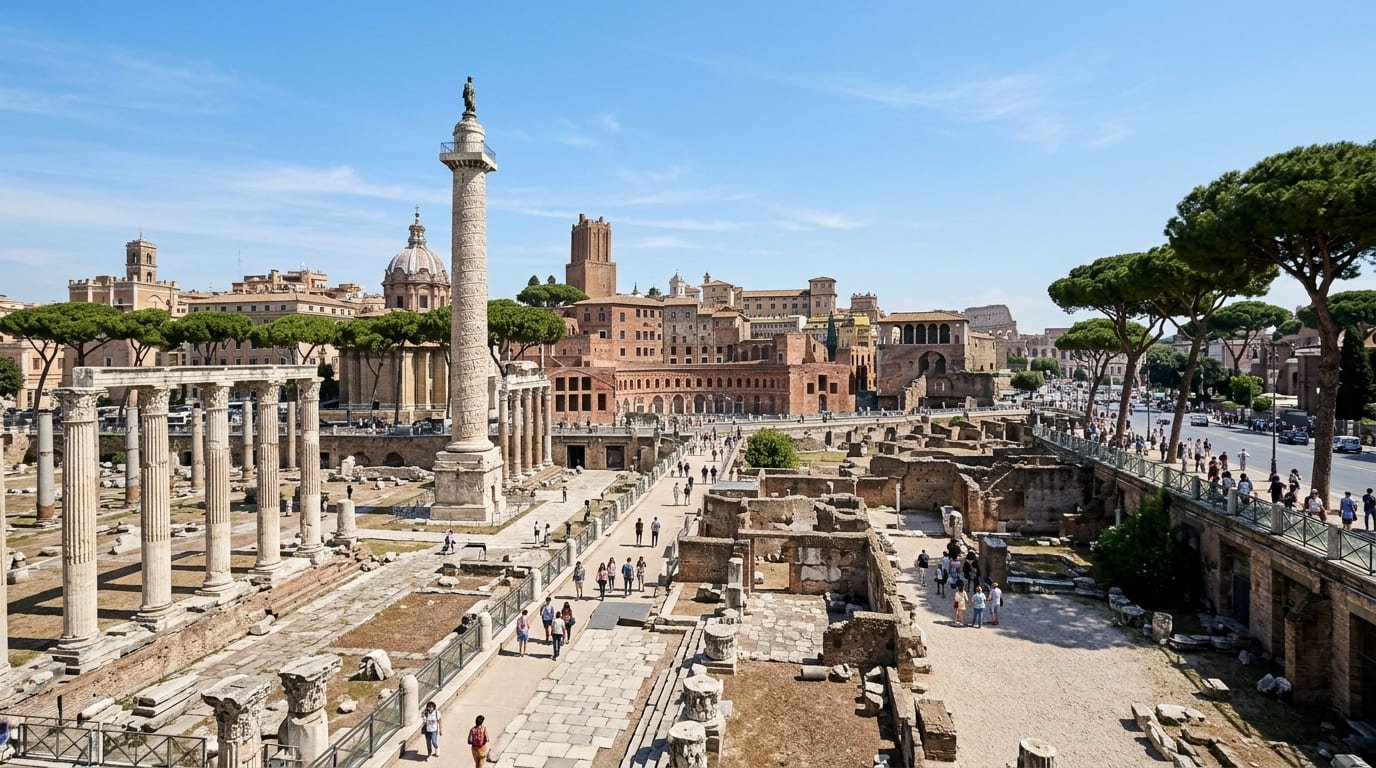
Built between 107 and 113 AD by the brilliant architect Apollodorus of Damascus, the Forum of Trajan was the grandest and final imperial forum:
- Trajan's Column (Colonna Traiana): Standing 38 metres high, this monument is wrapped in a continuous 190-metre spiral relief depicting Emperor Trajan's two Dacian campaigns in 155 dramatic scenes featuring over 2,500 carved figures.
- Trajan's Market (Mercati di Traiano): A multi-tiered red-brick commercial complex terraced into the Quirinal Hill, often described by historians as the world's first covered shopping mall.
Ludus Magnus: The Gladiator Training Barracks
Located just 100 metres east of the Colosseum across Via Labicana lies the Ludus Magnus - the primary imperial gladiatorial training academy built by Emperor Domitian.
From the street sidewalk, visitors can look down into the excavated brick ruins: an exact miniature replica of the Colosseum arena floor surrounded by tiered seating, where gladiators practiced and conditioned, connected to the Colosseum basement via an underground tunnel.
Circus Maximus: Rome's Chariot Racetrack
A short 5-minute walk southwest of the Colosseum lies the Circus Maximus - Rome's colossal chariot racing stadium that held over 150,000 shouting spectators, nestled in the valley between the Palatine and Aventine hills.
Frequently Asked Questions
Standard general admission includes Colosseum Levels 1 & 2, the Roman Forum, and Palatine Hill. Special areas like the Arena Floor and Underground require specific upgraded tickets or guided tours.
Colosseum tickets and guided tours sell out rapidly in 2026. For peak months (April to October), book 2 to 4 weeks ahead to secure your desired entry time slot.
Colosseum entry is tied to your specific booked time slot. Access to the Roman Forum and Palatine Hill is valid on the same ticket for 24 hours from your first entry.
Airport-style security checkpoints with metal detectors and X-ray scanners are mandatory for all visitors. Expect waiting times of 15–20 minutes at security, even with fast-track reserved slots.
Yes, official guided tours are offered in English, Italian, Spanish, French, German, and several other languages daily. Wireless headsets are provided so you can hear your licensed guide clearly.