📖 Table of Contents
What Is the Colosseum Hypogeum?
Derived from the Greek words hypo (below) and gaia (earth), the Hypogeum is the complex, two-storey subterranean basement constructed directly beneath the arena floor. While the amphitheatre was inaugurated under Titus in 80 AD, it was his brother and successor, Emperor Domitian (81–96 AD), who engineered this permanent underground labyrinth. Access to the subterranean hypogeum is strictly restricted to specialized guided visits; see our Colosseum underground tour guide or compare all Colosseum tickets and tours.
Spanning the entire oval footprint of the arena, the Hypogeum consisted of stone corridors, storage vaults, animal dens, and drainage canals. Before its construction, the arena floor could be flooded for sea-battle simulations; Domitian replaced that capability with an unprecedented theatrical machine that allowed combatants, scenery, and ferocious predators to materialize onto the surface as if by magic.
Underground Engineering: Lifts, Winches & Pulleys
The Roman Colosseum was the apex of ancient hydraulic and mechanical engineering. Hidden beneath the timber floorboards were dozens of lifting machines powered entirely by human muscle:
Vertical wooden elevator cages guided along timber tracks, hauled up by ropes wound around bronze capstans turned by teams of enslaved laborers.
As each lift reached the ceiling, a counterweight mechanism pushed open a trapdoor in the arena sand, unleashing wild animals directly into the ring to startle fighters and crowds.
Larger platforms capable of raising entire artificial forests, miniature hills, and simulated temples from the basement into the sunlight in mere minutes.
The Gladiators' Final Walk: Staging & Secret Tunnels
The Hypogeum was not merely storage; it was the nerve center of imperial combat. Subterranean corridors connected the Colosseum directly to external imperial institutions without combatants ever having to cross the crowded streets of Rome:
- The Ludus Magnus Corridor: A brick-lined underground passageway ran east directly from the hypogeum to the Ludus Magnus, Rome's primary gladiator training academy. Gladiators suited up in their barracks, warmed up in the practice arena, and walked through this private tunnel straight into the Colosseum depths.
- The Imperial Passage (Passaggio di Commodo): A private vaulted corridor allowed the Emperor and his imperial guard to enter the royal box directly from the Palatine Hill or Esquiline palaces without walking through the public plaza.
Sensory Atmosphere of the Ancient Basement
Historical accounts describe the ancient underground as dark, stifling, and terrifying. Lit only by smoking olive oil lamps and torches, the tunnels echoed with the roars of starving lions, clashing steel, chanting stagehands, and the scent of wild animal musk, incense, and blood dripping through the floorboards above.
What You See on an Underground Tour
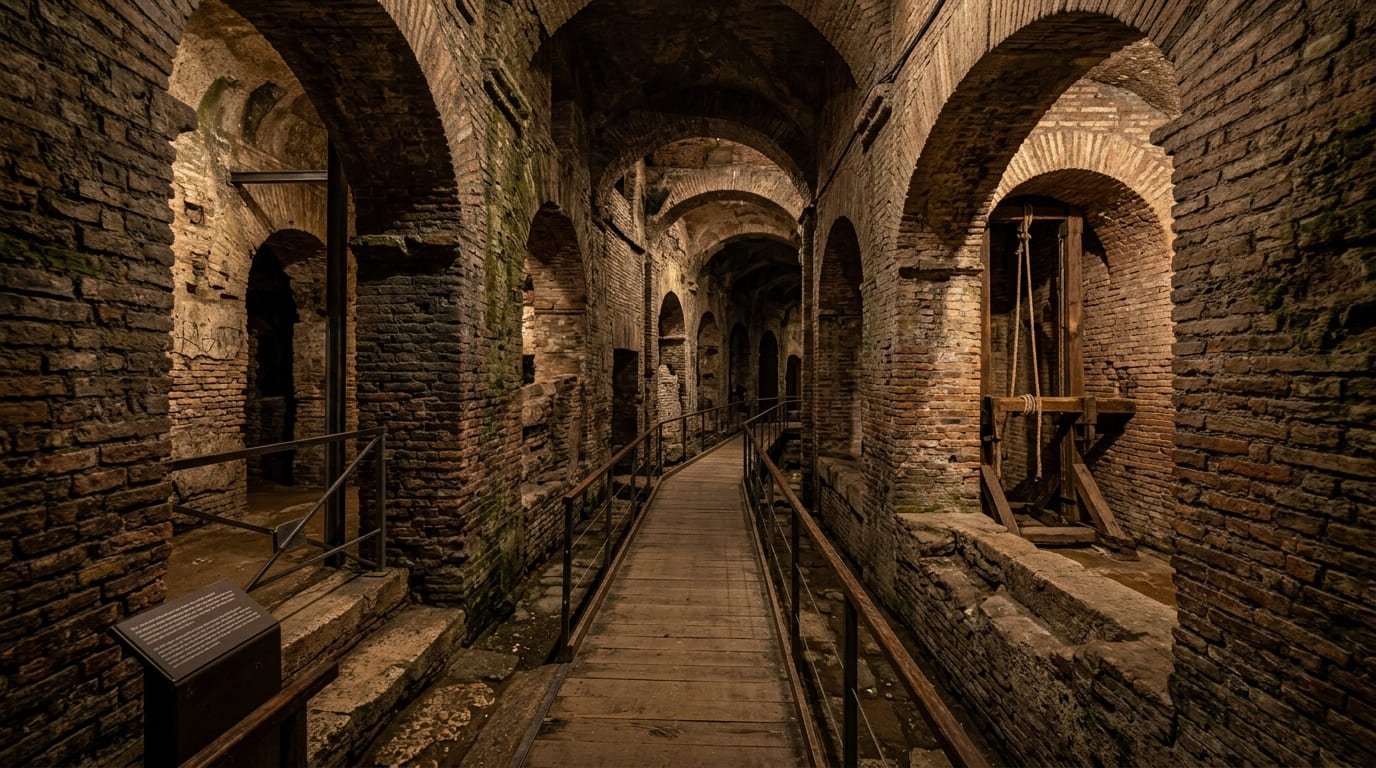
Following a massive restoration funded by Tod's in 2021, an elevated wooden walkway system leads visitors safely through the once-forbidden subterranean chambers:
- Central Vaulted Axis: Walk down the primary spine of the basement where animal cages were lined up awaiting their turn on the lifting machines.
- Reconstructed Wooden Lift: An authentic full-scale working model of a Roman animal lift and trapdoor winch built by experimental archaeologists, showing the ropes, pulleys, and wooden cage dimensions.
- Bronze Capstan Sockets: Original Roman bronze circular sockets set into the travertine flagstones where vertical wooden windlasses were anchored.
- Imperial Water Channels: The ancient subterranean drainage sewer system connected to the Cloaca Maxima, which evacuated groundwater and blood after the games.
How to Book Colosseum Underground Access in 2026
Because the underground chambers are fragile and enclosed, independent unaccompanied visits are strictly forbidden. You must join an accredited official guided tour or book an authorized Full Experience Underground ticket.
These tickets are released in strictly regulated monthly batches and sell out within seconds. If official standard slots are unavailable, booking an authorized premium guided tour is the only dependable method to secure entry.
Frequently Asked Questions
Standard general admission includes Colosseum Levels 1 & 2, the Roman Forum, and Palatine Hill. Special areas like the Arena Floor and Underground require specific upgraded tickets or guided tours.
Colosseum tickets and guided tours sell out rapidly in 2026. For peak months (April to October), book 2 to 4 weeks ahead to secure your desired entry time slot.
Colosseum entry is tied to your specific booked time slot. Access to the Roman Forum and Palatine Hill is valid on the same ticket for 24 hours from your first entry.
Airport-style security checkpoints with metal detectors and X-ray scanners are mandatory for all visitors. Expect waiting times of 15–20 minutes at security, even with fast-track reserved slots.
Yes, official guided tours are offered in English, Italian, Spanish, French, German, and several other languages daily. Wireless headsets are provided so you can hear your licensed guide clearly.