📖 Table of Contents
- What Is the Colosseum Arena Floor?
- The Ancient Surface vs Modern Reconstruction
- What Happened on the Arena Floor: Combat & Spectacle
- The Gates of Life and Death
- Key Sights: Trapdoors, Cross & Hypogeum Overlook
- How to Access the Arena Floor in 2026
- Arena Floor vs Standard Entry vs Underground
- Frequently Asked Questions
What Is the Colosseum Arena Floor?
The Latin word harena literally means "sand" - a reference to the thick layer of absorbent volcanic pozzolana sand spread across the wooden floor to absorb the blood of fallen gladiators and wild animals during imperial spectacles. To walk on the reconstructed gladiator stage, book an arena floor guided tour or compare all Colosseum tickets.
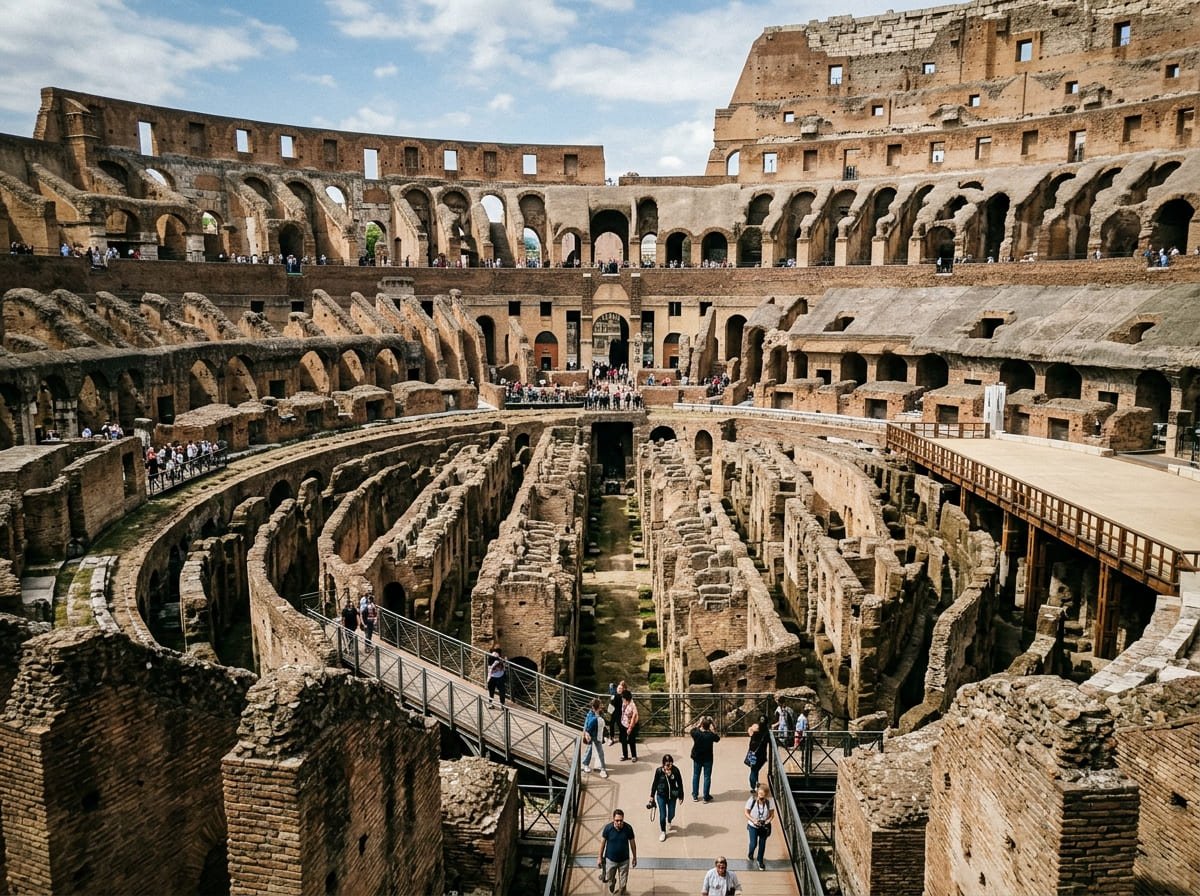
Measuring 83 metres long by 48 metres wide, the arena floor formed the beating heart of the Flavian Amphitheatre. Suspended directly above a two-storey subterranean maze of corridors, lifting cages, and animal holding pens (the Hypogeum), the floor served as a dynamic theatrical stage where imperial Roman engineers created jaw-dropping visual illusions.
Did You Know?
During the inaugural 100-day games held under Emperor Titus in 80 AD, early chroniclers like Cassius Dio recorded that the arena was temporarily flooded with water to host naumachiae (mock naval battles), featuring miniature warships and aquatic displays before the permanent underground hypogeum was installed under Domitian.
The Ancient Surface vs the Modern Reconstruction
For centuries following the fall of Rome, earthquakes, stone quarrying, and exposure to the elements stripped away the original timber decking of the arena, exposing the subterranean hypogeum masonry beneath. Visitors looking into the Colosseum saw an open pit of brick tunnels rather than the unified combat stage of antiquity.
The 2021 High-Tech Platform
In 2021, the Italian Ministry of Culture unveiled a state-of-the-art sustainable wooden platform covering the eastern half of the arena floor (approx. 3,000 square metres). Crafted from sustainably harvested Accoya timber, this reversible floor accomplishes two major goals:
- Visitor Experience: Allows ticket holders to walk out into the center of the amphitheatre and experience the overwhelming sensation of looking up at the towering tiers from the gladiator's viewpoint.
- Preservation: Shields the underground hypogeum masonry directly underneath from torrential rainfall and UV degradation, featuring built-in solar-powered ventilation slats that naturally regulate underground humidity.
What Happened on the Arena Floor: Combat & Spectacle
Imperial Roman games (ludi) held on the arena floor followed a strictly choreographed daily itinerary designed to display the emperor's generosity, supreme authority, and dominion over nature:
Staged hunts featuring exotic beasts imported from across the empire - lions, leopards, elephants, bears, rhinos, and crocodiles - set against elaborate portable scenery with live trees and painted backdrops.
Public executions of convicted criminals, runaway slaves, and prisoners of war through damnatio ad bestias (exposure to beasts) or theatrical re-enactments of deadly Greek myths.
The main event: professional gladiator combat matched by weapon class (Murmillo, Retiarius, Thraex, Secutor) under the watchful eyes of referees and thousands of shouting spectators.
The Gates of Life and Death
The arena floor was anchored by two monumental portals positioned along its major axis, each imbued with profound symbolic meaning for the combatants:
- Porta Triumphalis (The Gate of Triumph): Located on the western end toward the Roman Forum. Glasiators entered the arena through this monumental archway in a grand procession (pompa), saluting the editor of the games and the imperial podium. Surviving victors exited triumphantly through this gate carrying palm fronds and prize money.
- Porta Libitinaria (The Gate of Death): Positioned directly opposite on the eastern axis facing the Celian Hill. Named after Libitina, the ancient Roman goddess of funerals and burials. Slain combatants and dead beasts were dragged out through this portal using hooks and carted away to the Spoliarium morgue to be stripped of armor.
Key Sights: Trapdoors, Cross & Hypogeum Overlook
When you step onto the wooden arena platform today, look out for these remarkable historical features:
- The 36 Trapdoor Locations: Looking over the safety railing into the uncovered western half, you can see the precise masonry shafts where counterweight lifts pushed wild animals and scenery through trapdoors directly onto the sand.
- The 360-Degree Seating Panorama: From this central vantage point, the steep rake of the cavea becomes obvious. You clearly see how the Roman social classes were partitioned, from the imperial podium right up to the wooden attic tier 48 metres overhead.
- The Christian Cross: On the northern rim of the arena stands a large black wooden cross erected in 1927, commemorating the historic 1750 consecration of the Colosseum as a sacred shrine by Pope Benedict XIV in memory of Christian martyrs.
- The Emperor's Box (Pulvinar): Situated on the south podium edge, this elevated platform held the throne of the Emperor and his immediate family, giving them an unobstructed view of the combat mere yards away.
How to Access the Arena Floor in 2026
The Arena Floor is a restricted archaeological zone with strict capacity controls to prevent overcrowding and structural wear. General admission tickets do NOT permit access onto the arena platform.
Booking Requirement
To walk onto the arena floor, you must book an official ticket that includes "Full Experience - Arena" or join an accredited Colosseum Guided Tour with Arena Access. Spaces are capped daily and consistently sell out weeks ahead during peak travel months (April through October).
Visitors holding arena access enter through a dedicated VIP corridor on the ground floor, bypassing the standard security crush and emerging directly through the Gate of Death onto the wooden platform.
Arena Floor vs Standard Entry vs Underground
| Feature | Standard Ticket | Arena Floor Ticket | Underground Tour |
|---|---|---|---|
| Arena Platform Access | ❌ No (Overlook only) | ✅ Yes (Full access) | ✅ Yes (Included in tour) |
| Hypogeum Tunnels | ❌ No | ❌ No | ✅ Yes (Subterranean walk) |
| Levels 1 & 2 Overlooks | ✅ Yes | ✅ Yes | ✅ Yes |
| Roman Forum & Palatine | ✅ Included (24h) | ✅ Included (24h) | ✅ Included (24h) |
| Crowd Density | High (General public) | Low (Capped groups) | Very Low (Max 25 people) |
Frequently Asked Questions
Standard general admission includes Colosseum Levels 1 & 2, the Roman Forum, and Palatine Hill. Special areas like the Arena Floor and Underground require specific upgraded tickets or guided tours.
Colosseum tickets and guided tours sell out rapidly in 2026. For peak months (April to October), book 2 to 4 weeks ahead to secure your desired entry time slot.
Colosseum entry is tied to your specific booked time slot. Access to the Roman Forum and Palatine Hill is valid on the same ticket for 24 hours from your first entry.
Airport-style security checkpoints with metal detectors and X-ray scanners are mandatory for all visitors. Expect waiting times of 15–20 minutes at security, even with fast-track reserved slots.
Yes, official guided tours are offered in English, Italian, Spanish, French, German, and several other languages daily. Wireless headsets are provided so you can hear your licensed guide clearly.