📖 Table of Contents
Why Was the Colosseum Built? Political Propaganda
Following the tyrannical reign and suicide of Emperor Nero in 68 AD, Rome erupted into a devastating civil conflict known as the "Year of the Four Emperors." When general Vespasian seized control in 69 AD, founding the Flavian Dynasty, he desperately needed a grand civic gesture to heal the empire and win the loyalty of the Roman public. Walk through 2,000 years of gladiatorial and imperial history in person by reserving Colosseum tickets online.
Vespasian made a masterstroke of political propaganda: he drained Nero's private artificial lake at the lavish Domus Aurea (Golden Palace) and used the land to erect the world's greatest amphitheatre for public entertainment. Land that Nero had stolen for private pleasure was symbolically returned to the citizens of Rome.
Construction Timeline & The Flavian Dynasty
- 72 AD - Groundbreaking: Vespasian initiates construction, funded by massive gold and treasure looted during the sack of Jerusalem (70 AD), utilizing tens of thousands of Jewish prisoners of war for heavy quarrying.
- 79 AD - Vespasian Dies: The amphitheatre is complete up to the third tier when Vespasian passes away. His eldest son Titus succeeds him.
- 80 AD - Inaugural Games: Titus dedicates the monument with 100 consecutive days of lavish public games, during which over 9,000 wild animals are slain.
- 81–96 AD - Domitian's Additions: Titus's younger brother Domitian completes the 4th attic tier and engineers the complex subterranean Hypogeum.
Architectural Genius: Arches, Concrete & Orders
The Colosseum was an engineering marvel made possible by three revolutionary Roman techniques:
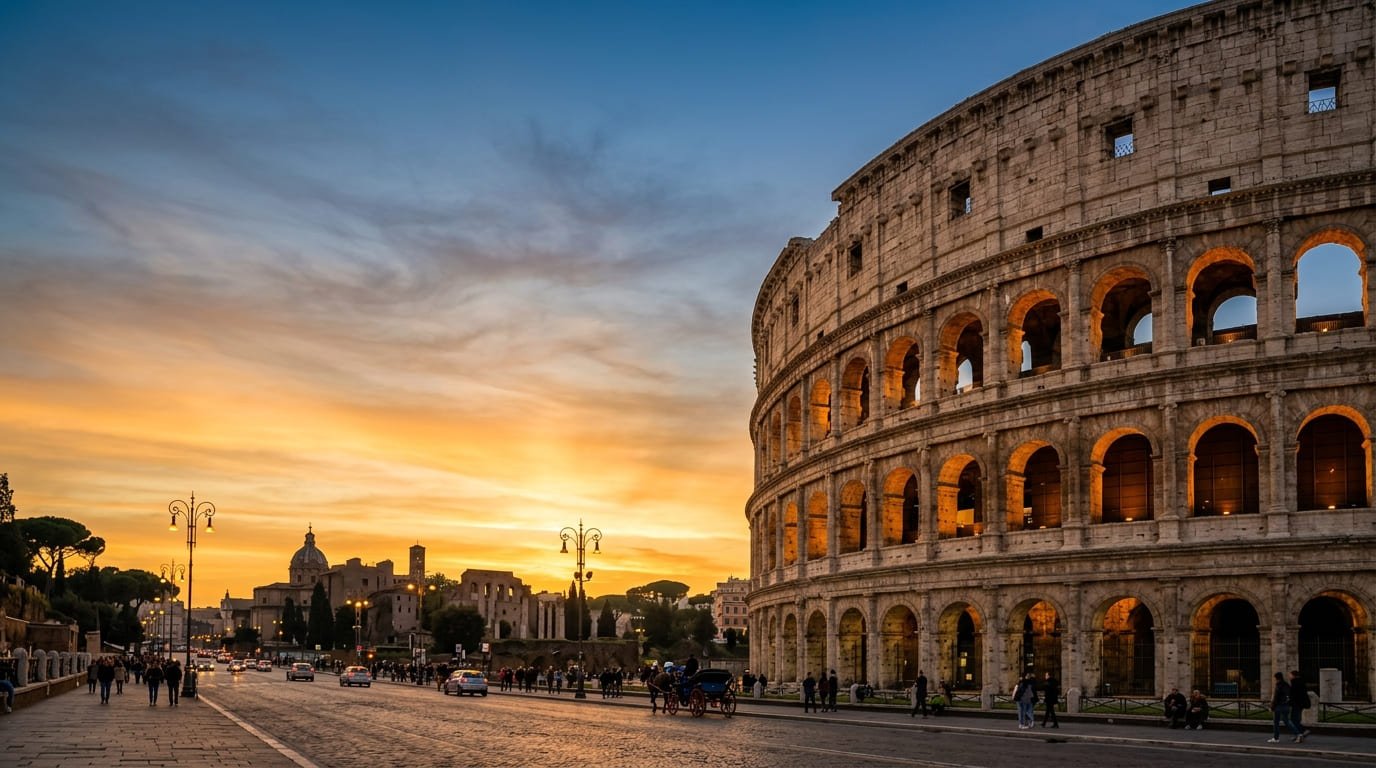
The exterior stacks Greek architectural orders vertically: robust Doric/Tuscan arches on ground level, elegant Ionic arches on tier 2, and ornate Corinthian arches on tier 3.
Lightweight volcanic pozzolana concrete allowed Romans to pour massive annular barrel and groin vaults, supporting thousands of tons without buckling.
100,000 cubic metres of travertine ashlar stones were laid without mortar, bound together by 300 tons of molten iron clamps set into lead sockets.
Decline, Earthquakes & 18th-Century Rescue
The last recorded gladiatorial games occurred in 404 AD (outlawed by Emperor Honorius), with animal hunts lasting until 523 AD under the Ostrogothic king Theodoric. As Rome's population collapsed from over a million to fewer than 30,000 during the early Middle Ages, nature and human destruction took their toll:
- Catastrophic Earthquakes: Major seismic tremors in 443, 847, and especially 1349 collapsed the entire southern exterior wall, creating the distinctive lopsided silhouette we recognize today.
- The "Pockmarks": The thousands of small holes peppered across the exterior travertine facade are scars left by medieval scavengers who gouged out the expensive ancient iron clamps to melt into tools and weapons.
- Modern Restoration: Following centuries of quarrying, Pope Benedict XIV consecrated the ruins in 1750. In the 19th and 20th centuries, massive brick buttresses (such as the Stern buttress) were built to stabilize the precarious surviving outer arches.
Frequently Asked Questions
Standard general admission includes Colosseum Levels 1 & 2, the Roman Forum, and Palatine Hill. Special areas like the Arena Floor and Underground require specific upgraded tickets or guided tours.
Colosseum tickets and guided tours sell out rapidly in 2026. For peak months (April to October), book 2 to 4 weeks ahead to secure your desired entry time slot.
Colosseum entry is tied to your specific booked time slot. Access to the Roman Forum and Palatine Hill is valid on the same ticket for 24 hours from your first entry.
Airport-style security checkpoints with metal detectors and X-ray scanners are mandatory for all visitors. Expect waiting times of 15–20 minutes at security, even with fast-track reserved slots.
Yes, official guided tours are offered in English, Italian, Spanish, French, German, and several other languages daily. Wireless headsets are provided so you can hear your licensed guide clearly.